
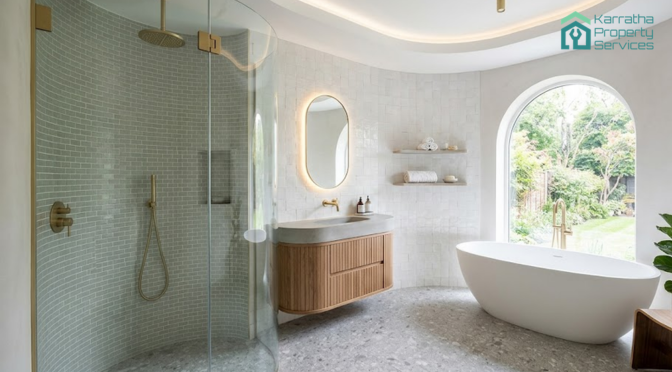
Have sharp corners dominated bathroom design for too long? In 2026, homeowners and designers are increasingly turning to softer silhouettes, rounded vanities, arched mirrors, curved shower screens and organic basin shapes.
Curves are not simply a decorative trend. They reflect a broader shift towards bathrooms that feel warmer, calmer and more connected to everyday wellbeing. Current bathroom design coverage shows curved forms becoming a defining feature of contemporary renovations, often paired with natural materials, warm colours and spa-inspired details.
But what makes curves so appealing, and are these bathroom renovations in Karratha practical beyond their visual impact?
Why Are Curves Appearing Everywhere in Bathroom Design?
Traditional bathrooms often rely on straight walls, rectangular vanities, square mirrors and sharp corners. While these elements can create a clean appearance, they can also make a room feel rigid.
Curved features introduce visual movement. Instead of directing the eye from one hard edge to another, rounded forms create a softer transition between different areas. Designers are combining curves with stone, timber, textured surfaces and warm neutral palettes to create bathrooms that feel less clinical and more inviting.
Can Curves Make a Bathroom Feel More Relaxing?
Yes, and this is one of the strongest reasons behind this trend of home renovation in Karratha. Bathrooms are increasingly being designed as spaces for relaxation rather than purely functional rooms. Spacious showers, freestanding baths, layered lighting and natural finishes are helping create a more restorative atmosphere.
Curved forms complement this wellness-focused approach because they can visually soften the room. An arched mirror above a rounded vanity or an oval bath can create a more relaxed composition than a collection of rigid rectangular fixtures.
The result is subtle. Curves do not necessarily make a bathroom luxurious on their own. They work best when combined with thoughtful lighting, suitable materials and a well-planned layout.
Are Curved Vanities a Practical Choice?
A curved vanity can be both stylish and functional.
Rounded or softened vanity edges can reduce the prominence of hard corners, which can be particularly useful in compact bathrooms where people move around fixtures frequently. Curved vanities are also being used as statement pieces. A softly bowed front or rounded end can give a relatively simple bathroom a distinctive focal point without requiring elaborate decoration.
However, the shape should suit the available floor area. A curved vanity can require different clearances from a standard rectangular unit, so dimensions should be considered during the planning stage rather than added as an afterthought.
Do Curves Work Well in Small Bathrooms?
Interestingly, they can.
Small bathrooms often contain numerous hard surfaces and right angles. Introducing a curved vanity, rounded basin or pill-shaped mirror can interrupt this visual repetition. Recent renovations in Karratha specifically highlight curves as a useful approach for compact bathrooms. Softer edges can make a tight space feel more considered and less visually rigid.
However, curves are not a substitute for good spatial planning. A poorly positioned curved fixture can still make circulation difficult. The priority should always be maintaining comfortable access around the toilet, vanity and shower.
Which Curved Features Are Popular?
You do not need to redesign every element of a bathroom to embrace the trend.
Some popular options include:
- Curved or rounded vanities
- Arched mirrors
- Oval basins
- Rounded freestanding baths
- Curved shower screens
- Arched shower niches
- Rounded tapware profiles
- Bullnose stone or benchtop edges
- Softly curved lighting fixtures
The most effective approach is often selective. One or two curved elements can establish the design direction without making the room look overly themed.
Can Curves Make a Bathroom Look More Expensive?
They can create a more bespoke appearance, but the result depends on execution.
A carefully designed curved vanity or sculptural basin can become a focal point. High-quality materials, precise installation and balanced proportions will generally have more influence on perceived quality than the shape alone. There is also a risk of overusing the trend. If every fixture has a different curved profile, the room can lose visual structure.
A strong bathroom renovation in Karratha balances soft and linear elements. For example, a curved vanity can work particularly well against straight tile lines or a simple rectangular floor layout.
Are Curved Bathrooms Difficult to Clean?
Not necessarily.
Cleaning depends more on the specific fixture, material, joints and detailing than on whether a surface is curved. Some rounded designs can actually reduce sharp corners where grime might accumulate. However, complicated curves, heavily textured surfaces and poorly designed recesses can create additional cleaning challenges.
When selecting curved fixtures, consider access for cleaning as well as appearance. A beautiful feature of home renovation in Karratha that is difficult to maintain may become frustrating over time.
How Can You Introduce Curves Without Overdoing Them?
Start with one focal feature.
An arched mirror is a relatively simple way to introduce softness. A curved vanity creates a stronger design statement. For a larger renovation, an oval bath or curved shower screen can become part of the overall layout.
You can also repeat the same visual language subtly. For example, pair an arched mirror with rounded tapware and softly curved vanity corners. The objective is cohesion, not repetition.
What Should You Consider Before Choosing Curved Fixtures?
Before committing to a curved bathroom design, consider:
- Available floor space
- Fixture dimensions
- Circulation around the bathroom
- Cleaning access
- Plumbing requirements
- Material durability
- Storage capacity
- Compatibility with existing features
- Long-term visual appeal
A bathroom renovation in Karratha should begin with function. Once the layout works, curved elements can add personality and softness without compromising usability.
Ready to Soften Your Bathroom Design?
Talk to our team today for stylish bathroom renovations in Karratha. Discover how carefully planned curves can transform your bathing space into a stylish, comfortable and functional retreat. Get in touch with Karratha Property Services, discuss your needs, and we’ll arrange a quote shortly!
FAQs
Q: Do curved bathroom fixtures cost more than standard designs?
Some curved products can cost more because of their specialised manufacturing and materials. However, pricing varies considerably between products, brands and finishes. Comparing the full installed cost is more useful than comparing the fixture price alone.
Q: Can I combine curved fixtures with a minimalist bathroom?
Absolutely. Curves can work particularly well with minimalist design because they introduce visual softness without requiring additional decorative elements. A simple curved vanity or arched mirror can become the main feature.
Q: Are curved shower screens practical for everyday use?
They can be, provided the screen is appropriately designed and installed for the available space. The shape should not compromise access, drainage, ventilation or usable showering space.
Q: How can I make a curved bathroom look timeless?
Use curves selectively and combine them with durable, understated materials. A neutral palette, quality fixtures and balanced proportions can help ensure the design remains appealing after the current trend fades.